
Orserdu Package Insert: Key Information from the Official Prescribing Document refers to the organized, clinician-oriented summary that accompanies a prescription medicine. This document typically consolidates core regulatory, clinical, and safety information into discrete sections such as indications, dosing, contraindications, warnings, adverse reactions, and pharmacology. Its purpose is to present factual details that support informed clinical decision-making, help coordinate safe use among prescribers and pharmacists, and provide a basis for counseling patients about expected effects and precautions.
The package insert concept also emphasizes structure and traceability: clinical trial references, pharmacokinetic data, and manufacturing or storage instructions are often included to support the stated content. While the insert is not a substitute for clinical judgment, it may serve as the authoritative source for labeling-approved indications and standard administration guidance. Differences between national regulatory jurisdictions can affect phrasing and the scope of included material, and readers may find comparable layouts across many prescription-product labels.

Indications and usage sections commonly summarize the clinical settings for which regulatory authorization was sought and granted. These entries often reference pivotal trial populations, endpoints, and the intended patient groups. In practice, clinicians may consult this section to verify whether a patient’s condition aligns with the approved use. The wording tends to be specific about the studied indication and may include qualifiers about lines of therapy, disease stage, or required diagnostic criteria used in trials.
Dosage and administration passages typically present initial dosing, titration patterns where applicable, and guidance for special populations such as individuals with renal or hepatic impairment. These statements may reference body-weight or surface-area calculations when relevant. Administrators and pharmacists often rely on this section for preparation instructions, timing relative to meals or procedures, and recommendations for monitoring response. The text may also list preparatory or reconstitution steps for parenteral formulations.
Contraindications and warnings are structured to help identify circumstances where the medicine should not be used or where heightened vigilance is required. Contraindications are usually narrowly defined, reflecting situations with clear risk–benefit concerns. Warnings and precautions often enumerate potential serious risks observed during development or postmarketing that may warrant baseline testing, periodic monitoring, or temporary treatment interruption. The language may indicate severity levels and data sources that informed those recommendations.
Adverse reaction summaries frequently combine frequencies from controlled trials with postmarketing experience and may stratify events by system organ class. These sections can include tables or descriptive text that distinguish commonly reported events from rare but severe outcomes. Readers should note that reporting rates in clinical trials may differ from those seen in broader clinical practice because of trial selection criteria and monitoring intensity. Reporting mechanisms and contact information for adverse event reporting are typically provided.
In summary, the package insert consolidates product-specific factual content into labeled sections that may guide clinical use and safety monitoring. It can serve as a reference for indication limits, practical dosing considerations, recognized contraindications, and commonly observed adverse effects. The next sections examine practical components and considerations in more detail.The indications and usage portion of a package insert outlines the clinical contexts in which the product’s use was evaluated and authorized. This section typically names the disease state, the patient population studied (for example, adults versus pediatric groups), and any specific diagnostic criteria or biomarkers used in pivotal trials. It may also state whether use was evaluated as monotherapy or in combination with other agents. Readers should recognize that off-label uses exist in practice but are distinguishable from the indications documented in the insert.
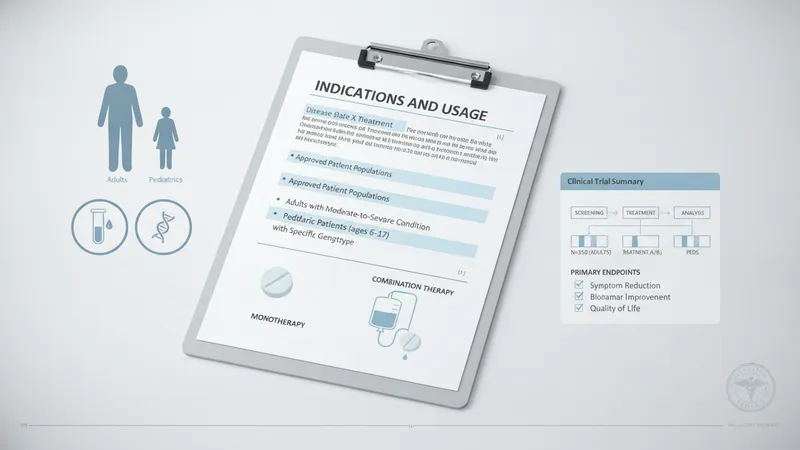
Clinical trial designs that support indications are often described in summary form or cited in the clinical studies section. The strength of evidence for an indication can vary depending on trial size, endpoints, and comparative controls; therefore, the insert may include references to the key studies without extending interpretive conclusions. Regulatory agencies generally expect that indication language reflect the populations and outcomes studied rather than extrapolations beyond those parameters.
When interpreting indication statements, clinicians may consider contextual factors such as disease severity, coexisting conditions, and prior therapies that were included or excluded in trials. In some therapeutic areas, labels include qualifiers such as “for patients who have received prior X therapy” or “for adults with Y condition,” which clarify how the study population maps to real-world patients. Such qualifiers are presented as factual descriptors rather than prescriptive mandates.
Documentation and recordkeeping associated with labeled indications may be relevant for formulary review, institutional guidelines, or payer assessment. The package insert may be used as a reference point in those processes, where the documented indication helps align clinical pathways and administrative policies. Readers should view the indications and usage text as the formal, label-based description of studied clinical contexts.
Dosage and administration guidance sets out practical parameters for initiating and maintaining therapy, including typical starting doses and common titration approaches. For treatments with narrow therapeutic indices or weight-based dosing, the insert may include calculation examples. It often addresses administration routes (oral, intravenous, subcutaneous) and any required preparation steps such as dilution, light protection, or warming. These instructions aim to reduce dosing errors and to standardize preparation in clinical settings.
Patient selection guidance often intersects with dosing recommendations. The insert can include considerations for modifying dose in renal or hepatic impairment, or in the presence of interacting medications. For pediatric and geriatric populations, separate dosing tables or adjustment notes may appear where data exist. When evidence for specific subgroups is limited, the insert may state that data are insufficient to make firm dosing recommendations and may direct clinicians to monitor response closely.
Monitoring parameters that accompany dosing guidance may include laboratory tests, vital sign checks, or symptom-based assessments that can indicate efficacy or emerging toxicity. The insert often suggests timing for assessments based on pharmacokinetic properties such as half-life and time to steady state. In practice, clinicians and pharmacists may reconcile insert recommendations with institutional protocols and patient-specific factors when establishing a monitoring plan.
Practical considerations for administration logistics may address multi-dose vial use, handling of hazardous agents, or coordination with infusion centers. These operational details help facilities plan nursing resources and supply procurement. The insert’s level of operational detail varies by product type, and where gaps exist, facilities may reference professional guidelines or institutional policies to complement the label information.
Contraindications are typically concise statements identifying situations where the product should not be used because risks clearly outweigh potential benefits. These may include hypersensitivity to product components or concurrent conditions that create unacceptable safety concerns. Warnings and precautions expand on potential serious risks that require clinician awareness and may include monitoring recommendations, steps to take if a serious event occurs, and descriptions of populations at elevated risk.
Warnings often distinguish between risks observed during controlled clinical trials and those identified through postmarketing surveillance. The insert may describe the nature of the risk, incidence estimates from trials, and clinical signs to watch for. Language in this section may suggest baseline testing or periodic reassessment to detect adverse effects early. Such recommendations are framed as informational to support clinical judgment rather than prescriptive mandates.
Adverse reaction sections commonly report event frequencies using categories like common, less common, and rare, often derived from pooled clinical trial datasets. These summaries may include system organ class groupings and note serious events that received particular regulatory attention. Readers should expect that the frequency and character of adverse reactions in broader clinical practice can differ from trial reports due to patient heterogeneity and co-medications.
Pharmacovigilance mechanisms and reporting instructions are often included to facilitate postmarketing safety surveillance. The insert may provide contact information for reporting adverse events and describe the importance of submitting reports to regulatory systems. Institutions and clinicians can use these reporting channels to contribute to ongoing safety assessment, while recognizing that causality assessments evolve as additional data accumulate.
Drug interaction information in the package insert summarizes known or anticipated pharmacokinetic and pharmacodynamic interactions. This may include effects mediated via metabolic enzymes, transporter proteins, or additive pharmacologic activities. Statements typically cite studies that examined coadministration with common agents, and where data are lacking, the insert may note theoretical concerns. Interaction guidance often indicates whether dose adjustments, monitoring, or avoidance of certain combinations may be warranted.
Use in specific populations is addressed through sections on pregnancy, lactation, pediatrics, and geriatrics where data exist. These portions commonly describe available human data, animal study findings, or the absence of adequate information. They may also outline potential risks and recommend monitoring considerations. The content is typically cautious in tone and frames the information to assist risk–benefit discussions rather than to prescribe particular actions.
Clinical pharmacology and clinical studies sections provide the mechanistic and evidence-based foundation for label statements. Pharmacokinetic parameters such as absorption, distribution, metabolism, and elimination are often summarized alongside key findings from pivotal trials, including endpoint descriptions and trial populations. Readers may use this material to contextualize dosing decisions and to understand the evidence base underpinning labeled indications.
Storage, handling, and patient counseling information complete the practical aspects of the insert. Storage details (temperature ranges, light protection) and handling precautions help preserve product integrity, while patient counseling content gives clinicians suggested topics to discuss regarding expected effects, common adverse reactions, and safety precautions. The prescribing information reference points readers to the full authoritative label and supporting documents for further review.